Architectural influences in the film Metropolis
In this article we will analyze the architectural influences of Friz Lang’s film “Metropolis.” The film (1927) is a silent film masterpiece that has not only left an indelible mark on the history of cinema, but has also influenced the way we conceive architecture and urbanism in the 20th century. The architecture of “Metropolis” is fundamental to understanding its narrative, as it reflects the clash between social classes, modernity and the struggle for power in a futuristic context. The architectural influences present in the film are diverse, coming from styles such as Art Deco, Expressionism and Futurism, and they intertwine to create a dystopian city that has become a visual reference for future generations.
Art Deco in Metropolis
Art Deco, a style that became popular in the 1920s and 1930s, is one of the most obvious architectural influences in the film “Metropolis.” Characterized by geometric lines, sleek shapes, and elaborate ornamentation, this style is reflected in the skyscrapers and monumental buildings featured in the film. The city of Metropolis is a setting dominated by towering structures that seem to defy gravity, with angular shapes and repetitive patterns that convey a sense of opulence and modernity. The towers and skyscrapers, which appear infinitely tall, are reminiscent of the Art Deco buildings that were being built in cities like New York at the same time, such as the Empire State Building or the Chrysler Building.

The use of Art Deco in Metropolis also ties into the film’s theme. The style was a manifestation of the technological advancements and economic prosperity of the time, but in Metropolis, these elements become symbols of oppression and inequality, adding a layer of complexity to the city’s design.
Expressionism in Metropolis
Another major influence on the architecture in the film “Metropolis” is Expressionism, an art movement that emerged in Germany after World War I. Expressionism is characterized by its use of distorted and angular forms to convey intense emotions and moods. In “Metropolis,” this manifests itself through the twisted structures and forced perspectives that contribute to the atmosphere of tension and alienation that permeates the film.

The interiors of buildings, such as the cathedral and the laboratory of Rotwang the inventor, are designed in a gothic and expressionist style, which reinforces the dark and oppressive tone of the film. The use of light and shadow is another expressionist element that adds drama to the architecture, creating a feeling of eeriness and claustrophobia.
Futurism and the influence of the Bauhaus in Metropolis
“Metropolis” also draws on Futurism, a movement that celebrated technology, speed and the machine. The film’s massive machines and cityscape are visual representations of Futurism’s fascination with industry and progress. The streets crowded with moving cars and trains, along with the city’s infrastructure, suggest a society that has reached a high level of technological development, but at enormous human cost.
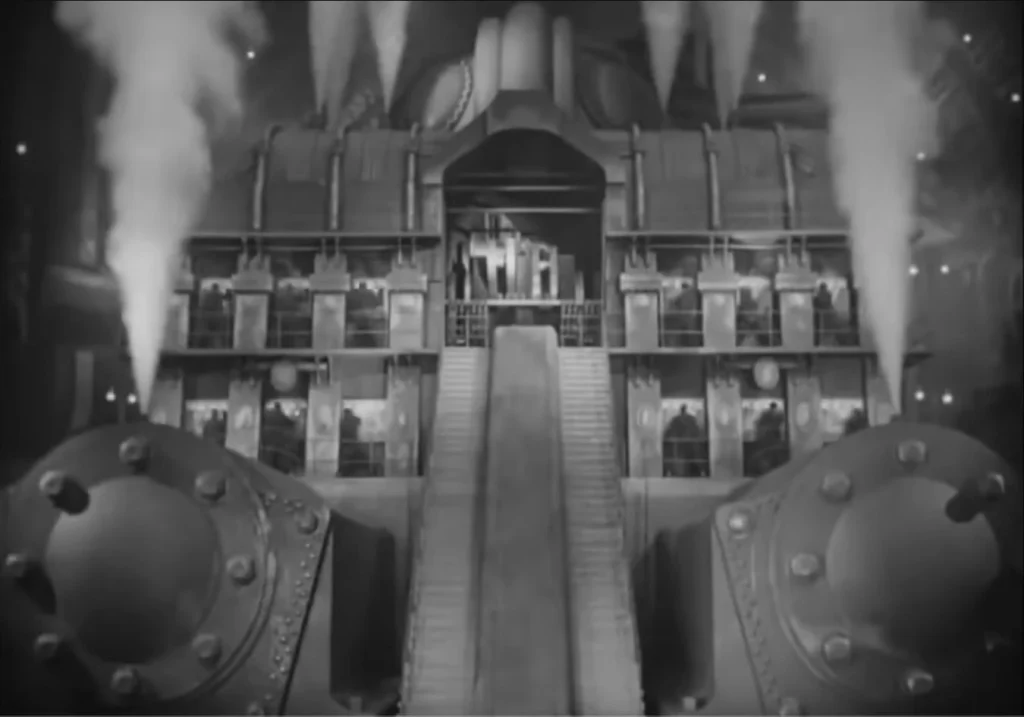
Furthermore, the influence of the Bauhaus, a German design school that promoted functionality and simplicity, can be seen in the layout and organization of spaces in “Metropolis.” The Bauhaus championed the idea that architecture should be functional and accessible, but in “Metropolis,” these principles are subverted to show a society that has lost the balance between technology and humanity.
Influence of royal cities
Fritz Lang was inspired by real cities like New York to create the imposing city of Metropolis. After visiting New York in 1924, he was fascinated by the magnitude of the skyscrapers and the energy of the modern metropolis, which is reflected in the film. The feeling of being surrounded by buildings that rise to the sky and the hustle and bustle of the crowded streets were captured in the futuristic and dystopian vision of “Metropolis.”
conclusion
“Metropolis” is a visionary work that combines architectural influences from styles such as Art Deco, Expressionism, Futurism and Bauhaus to create an urban landscape that reflects the complexity and tensions of modern society. The film not only captured the spirit of its time, but also anticipated many of the concerns about urbanism, technology and alienation that are still relevant today. The architecture in “Metropolis” remains a testament to how art and film can influence and be influenced by architecture and society.
The film can be viewed for free at the following link: Metropolis movie 1927
1 Comment
Gibeller Home Experience · at
Very interesting article, Basilio. Congratulations!
We talked about this very topic with Helia de San Nicolás in another episode of our podcast El Abrigo.
All the best