Low-enthalpy radiant-cooling ceiling: savings, sustainability and instant comfort
When we think about heating and cooling a house, we usually focus on the walls or the floor. Radiators, split systems, and underfloor heating have occupied a good portion of that space for years. However, the ceiling offers great potential and is often left unused. Radiant heating and cooling systems take advantage of this surface to provide efficient, comfortable, and discreet heating in winter and cooling in summer.
A radiant ceiling installation It incorporates panels through which water circulates at a controlled temperature, fully integrated into the roof and capable of transferring thermal energy to the space.
However, not all radiant ceilings work the same. Conventional radiant systems typically rely on high thermal mass, resulting in slow response times that can extend over several hours. In contrast, low-enthalpy radiant systems allow for virtually instantaneous activation, reaching their operating temperature in less than four minutes and adapting quickly to changes in occupancy or weather conditions.
Comfort also depends on how the temperature is distributed
One of the most interesting aspects of radiant systems is their ability to utilize a large surface area. Instead of concentrating heating or cooling in a single point, the energy is distributed much more evenly throughout the room.
Furthermore, elements that restrict the interior layout disappear, as there is no need for radiators occupying walls or visible indoor air conditioning units. For architects and interior designers, having these free spaces is especially appealing when seeking to make the most of every square meter or achieve a clean, minimalist aesthetic.
The operation is also completely silent. By primarily cooling through thermal radiation, it significantly reduces the drafts associated with other air conditioning systems.
Furthermore, low enthalpy radiant systems can offer three to four times more power per square meter of active surface than some conventional radiant systems, allowing spaces with higher thermal demands to be heated without compromising energy efficiency.
The false myth that "heat rises"«
When discussing radiant ceiling heating, many people still raise the same question: if heat rises, wouldn't it make more sense to install the heating in the floor?
The answer lies in differentiating between two distinct physical phenomena.
It is true that hot air rises by convection. However, a radiant ceiling does not primarily function by heating the air, but rather by emitting thermal radiation.
Radiation doesn't rise or fall. It travels in all directions and is absorbed directly by people, walls, furniture, and other surfaces in the room. It's the same physical principle by which the Sun heats the Earth.
For this reason, a well-designed radiant system can deliver excellent results from the ceiling, providing a uniform distribution of comfort and avoiding the stratification problems typical of systems that rely primarily on air movement.
In fact, the combination of high specific power with a virtually instantaneous response makes the low enthalpy radiant ceiling a particularly effective solution for both heating and cooling.
A particularly interesting pairing for aerothermal energy
Much of the potential of radiant ceiling heating is realized when combined with a heat pump. The heat pump produces the hot or cold water needed for the system and operates at temperatures that are particularly compatible with this type of emitter.
Low enthalpy radiant systems take particular advantage of this combination because they are able to deliver high performance while working at moderate temperatures, maximizing the efficiency of the heat pump.
However, the final consumption will always depend on factors specific to each property. Insulation, orientation, heat loss, climate, and usage habits all have a decisive influence on the results obtained.
Therefore, it's wise to be wary of solutions presented as universal. Before installing any radiant heating system, it's essential to properly assess the property and size the installation according to actual needs.
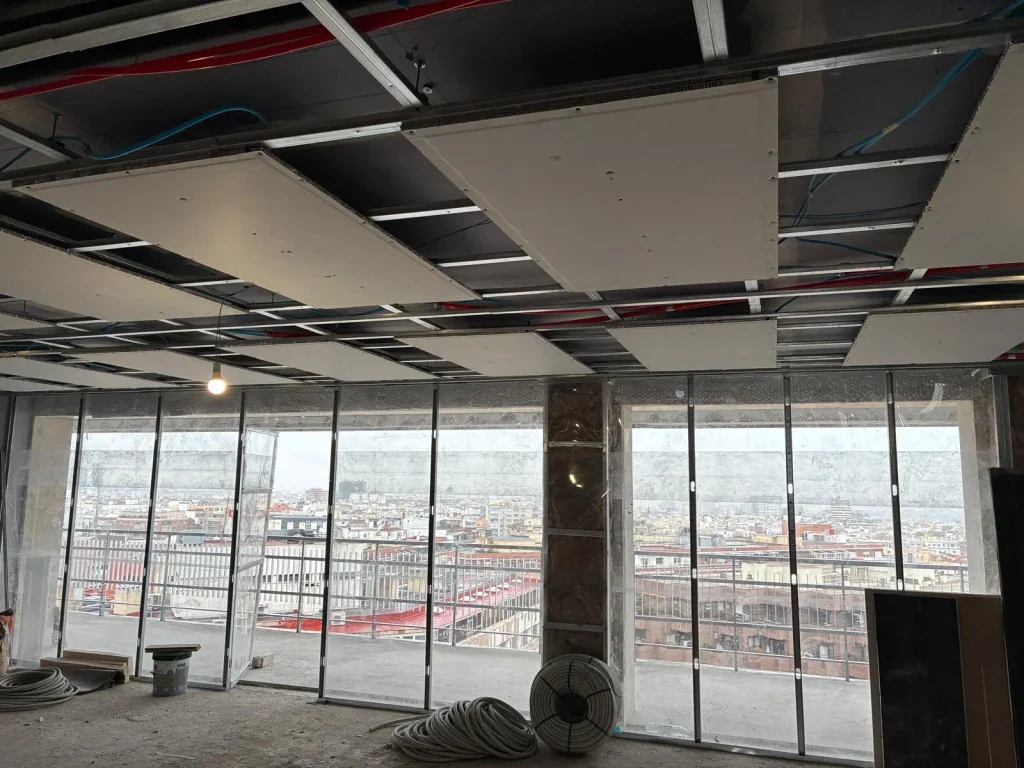
In Madrid, Autoconsun specializes in radiant heating solutions combined with aerothermal energy and even has a technical space where professionals can personally test their operation. This demonstrates how this technology is playing an increasingly important role in efficient climate control.
In the words of Carlos Jimeno, manager of Autoconsun:
«"Installing radiant ceiling heating with aerothermal energy is not just about installing a climate control system; it's about designing an energy solution tailored to each home. At Autoconsun, we study the space and the thermal needs of each client before proposing anything, because every project is different."»
Renovate without lifting the entire floor
Another practical advantage arises in certain renovations. Installing underfloor heating usually involves working on the existing floor. Working from the ceiling can avoid much of this work, especially when a suspended ceiling already exists or is planned.
This feature is especially interesting in renovations where the aim is to minimize construction time and preserve existing finishes.
That doesn't mean any house is automatically suitable. Available height, insulation, and construction characteristics will still influence the project, so preliminary analysis remains essential.
Energy efficiency that starts with the building
A radiant-cooling ceiling can significantly contribute to reducing energy consumption, especially when integrated into a well-insulated home and combined with an efficient heat pump.
It can also be complemented with photovoltaic self-consumption installations to take advantage of renewable energy generated in the home itself.
But energy efficiency begins long before choosing a heating and cooling system. Improving the building envelope, windows, insulation, and solar control remains essential for reducing a building's energy demand.
Within this global vision, the low enthalpy radiant-cooling ceiling represents a particularly interesting technological evolution, combining efficiency, comfort, speed of response and high thermal power in a system fully integrated into the architecture.
A solution that certainly deserves to be admired.



0 Comments