The evolution of construction materials
The history of humanity is written in its building materials. Every technological leap, from caves to skyscrapers, has depended on the ability to reinvent what we use to build. "evolution of construction materials" It not only reflects technical advances, but also cultural, environmental and social changes that have shaped our way of inhabiting the planet.
1. Prehistory and Antiquity: The foundations of civilization
At the dawn of civilization, humans turned to readily available natural resources. stone, the wood and the clay were the pillars of the first structures, as demonstrated by the megaliths of Stonehenge (United Kingdom, 3000 BC), built with blocks of sandstone and dolerite that still defy erosion. In Mesopotamia, the adobe —a mixture of mud, straw, and water—allowed the construction of entire cities, such as Ur, with dwellings that took advantage of natural thermoregulation. Egypt took stone to its maximum expression with the pyramids of Giza, where limestone blocks weighing up to 80 tons were assembled with millimeter precision. A key milestone was the discovery of lime by calcining limestone, giving rise to the first mortars used by Egyptians and Romans to join structures.
2. Classical Empires: Innovation and Durability
Rome revolutionized engineering with the Roman concrete, a mixture of lime, volcanic ash and water that allowed eternal works such as the Pantheon of Rome (126 AD), whose 43-meter dome remains standing thanks to the strength of the material. At the same time, the baked brick It was perfected in the Great Wall of China (7th century BC) and in Roman aqueducts, combining functionality and accessibility. Materials such as marble and the granite They became symbols of power, adorning temples such as the Parthenon in Athens or the Colosseum, where the stone was carved to tell stories of glory.

3. Middle Ages: Strength and symbolism
Gothic architecture elevated stone to new heights. Notre Dame Cathedral (Paris, 1345) exemplifies this period, with its limestone flying buttresses that redistribute loads and stained glass windows that filter divine light. In northern Europe, the Borgund Church (Norway, 1180) demonstrated the potential of structural timber, using oak beams assembled without nails. Meanwhile, in the East, the Great Mosque of Samarra (Iraq, 852) It dazzled with its helical minaret built with clay bricks, showing how the simplicity of materials could harbor spiritual greatness.

4. Industrial Revolution: Steel, glass and massive scale
The 19th century brought with it materials that redefined the urban landscape. steel, a product of blast furnaces, allowed wonders such as the Brooklyn Bridge (1883), whose steel cables supported the weight of a metropolis for the first time. industrial glass, mass-produced, transformed facades into canvases of light, as in the Department Store of Paris (1852), where huge glass windows illuminated commercial spaces. But perhaps the most disruptive invention was the Portland cement (1824), the basis of modern concrete, which facilitated the construction of dams, tunnels and entire cities on an unprecedented scale.

5. 20th Century: The era of reinforced concrete and plastics
The reinforced concrete —a symbiosis of concrete and steel— dominated the 20th century. Architects such as Le Corbusier used it in the Villa Savoye (1931), where pilotis and horizontal windows challenged aesthetic conventions. plastics, derived from petroleum, burst onto the scene: Plexiglass It was used in aircraft cockpits during World War II, and the PVC revolutionized pipes due to their durability and low cost. Materials such as stainless steel They found their pinnacle in works such as Gateway Arch of St. Louis (1965), a 192-meter arch that combines elegance and corrosion resistance.
6. 21st Century: Sustainability and Smart Materials
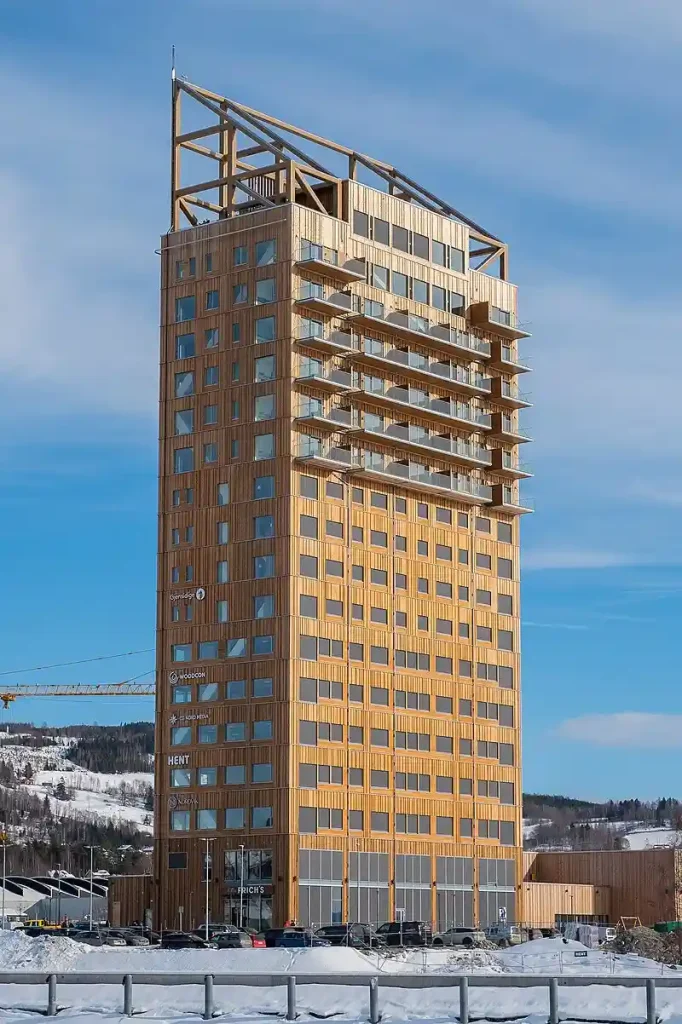
Today, innovation is focused on reducing environmental impact. cross-laminated timber (CLT) has re-emerged as an alternative to steel, as in the Mjøstårnet (Norway, 2019), an 85-meter building that demonstrates its resilience and low carbon footprint. The self-healing concrete, infused with crack-sealing bacteria, is being tested in projects such as the BioConcrete in the Netherlands, promising more durable structures. Examples such as the EcoARK Pavilion (Taiwan), built with 1.5 million recycled plastic bottles, or the aerogels —insulators 10 times more efficient than fiberglass—illustrate how science transforms waste into resources.
Challenges and future in the evolution of construction materials
The sector faces the challenge of reducing 40% of the global emissions it generates. Innovations such as bioconcretes, made from ash from agricultural waste, or the Carbicrete —which uses CO₂ to harden—point to a decarbonized industry. The 3D printing, used by companies such as ICON to build homes in less than 24 hours using special cement, could democratize access to decent homes. However, the real change lies in adopting a circular model, where materials are infinitely reused, as is already the case in construction projects. regenerative architecture that integrate living facades and on-site recycling systems.
The evolution of building materials is a tale of ingenuity and adaptation. From pyramids to graphene skyscrapers, each material has responded to the urgency of its time. Today, in the face of the climate crisis, the challenge is clear: create solutions that balance innovation, accessibility, and respect for the planet. As architect Shigeru Ban aptly summarizes: "Materials are neither traditional nor modern; they are simply tools to improve lives.".

0 Comments